Showing posts with label Coercive Acts. Show all posts

Philadelphia - Our First Capital

Philadelphia coat of arms

Philadelphia is rich with history, but even today, most do not know that Philadelphia was the largest city in the colonies for a long time.  Many do not know it also acted as the capital of our struggling country during the American Revolution.  How did the city of Philadelphia, certainly not the first settlement in the fledgling country, become “the place to be” during the 1700s?  Williamsburg was a bustling metropolis.  New York City was ideally located.  What made Philadelphia the place for the delegates to gather all those years ago?  In order to understand that, we must go back and look at its history.


William Penn
                                              
In 1646, the first church was built on Tinicum Island by the Swedish.  This group came to the area first, although that did not stop King Charles II from giving a land grant to William Penn in 1681. Before the Swedes and the Dutch arrived, the area was inhabited by the Lenape Indians.  The land we know of as Philadelphia and Pennsylvania was actually part of New Netherland when it was settled by the Dutch.  The English did try to establish a settlement in the area in 1642 near the Schuylkill River but the Swedes and Dutch burned their homes, so the settlers evacuated the area.
The Old Courthouse

As stated above, King Charles II of England gave the land grant to William Penn.  Only 50 Europeans were still surviving in the area by 1682.  The land called Pennsylvania by King Charles, was as repayment for William’s father’s loyalty to the Crown during the English Civil War when the Roundheads took over, kicking out King Charles’ father.  William Penn did not want the land named after him, but the king insisted.  When Penn arrived in the New World, he went about purchasing the land from the Lenape.  He was a Quaker and believed in peace.  He felt if he purchased the land from the native tribe, they would not attack the settlers for taking away the land.  This was a historic decision.  No other Englishman purchased the land from the native tribes, just taking what the kings had given them or taking what they wanted and calling it their own.
King Charles II

When William Penn planned the city of Philadelphia, he used a grid pattern because he wanted a uniformity that reminded him of London. He liked having the streets running north and south and east and west. The city itself got the name from “philos” for love/friendship and “adelphos” for brother.  The streets were first named for prominent landowners, but later were named for trees.   The city originally ran from the Delaware River to the Schuylkill River (east and west) and from South Street to Vine Street (north and south).  As more and more people settled around the city, it incorporated those areas into the city as well.  William Penn wanted the city wide and with orchards. Obviously if you walk the streets today, there certainly does not appear to be room for orchards.
Congress Hall and New Theater
First Bank
Library and Surgeon's Hall
Corner of Market
Second Street North

State's House

(Pictures from a display at Independence Center in Philadelphia.  I took them while traveling to that great city in 2011.)

By 1701, the city had grown to over 2500 people.  That was quite an explosion in only 20 years!  It wasn’t just English – it was Welsh, Irish, German, Swedes, Finns, Dutch, and African slaves who made up the population.  William Penn’s idea of religious freedom and a home for all.  Of course, at the time, slaves were arriving by ships from Africa, and while later Pennsylvania would abolish slavery, at this time, slavery was allowed.  James Logan became the first mayor in 1701.
Independence Hall

William Penn established a charter to make Philadelphia a city with aldermen, councilmen, and a mayor.  He felt it was important that everyone was represented by the government.  Philadelphia was ideally situated along the Delaware River, making it a perfect port for exporting and importing goods.  This also made it important for settlers.  They could arrive by ship here and then migrate to other areas in the colonies.  The main trade in Philadelphia was with the West Indies.  Sugar cane arrived as part of the Triangular Trading route.  As the surrounding areas of Philadelphia became agricultural, the people began to export grains, lumber, and flax seed.  While many first moved to Philadelphia seeking religious freedom, others arrived in search of opportunity.  After all, as a growing city – think of all the jobs which would need filling or even creating – bakers, cobblers, coopers, blacksmiths, etc.
William White

By 1750, Philadelphia was a major city.  Christ Church was the main place of worship although there were many other churches.  Men of all faiths often gathered at Christ Church to worship (remember the freedom of religion? Well, no one ever said – no you cannot worship here because it’s not your faith.)  The Pennsylvania State House was built here (we know it as Independence Hall).  Soon the streets were paved.  Schools were built as children were born and the families grew.  Even libraries, thanks to Benjamin Franklin, were established in the city.
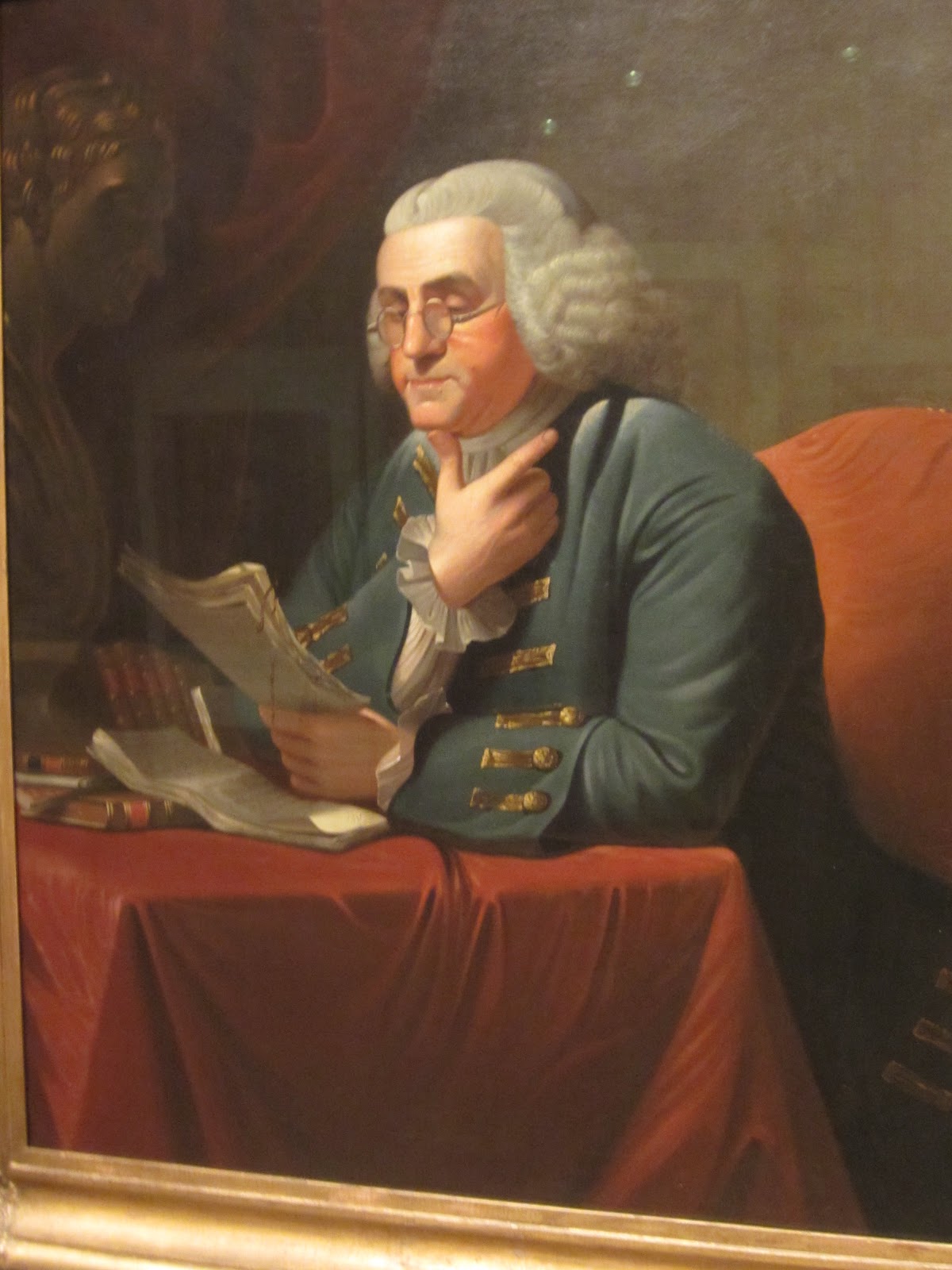
Benjamin Franklin

Benjamin Franklin arrived in Philadelphia in 1723 seeking his own fortune.  While he worked for his brother in Boston, he could not publish his writings.  He traveled to Philadelphia and soon had his own printing press and newspaper.  He was responsible for Philadelphia’s first firehouse, first library, first hospital, and many more places!!!  He was quite the forward thinking man!
In 1752 the first hospital opened.  The College of Philadelphia, which later became the University of Pennsylvania was established here.  Even a militia was formed to protect the city as tensions began to rise against the British.  The First AND Second Continental Congresses were both held in Philadelphia.  And of course, we all know that the Declaration of Independence was signed here in 1776.

A few other important Philadelphia men include:
Robert Morris – he began his life in Maryland in 1734.  He was a shipping partner with Thomas Willig.  He helped smuggle supplies to the city during the Revolutionary War.  He owned the President’s House and let George Washington live there.  It was the grandest house in the city after all and was perfect for our first president.

John Bartram – was born in 1699.  He was a botanist.  In 1765 he became the King’s botanist but later was known to discover many plants.  A high school in the city is named after him.  He founded the American Philosophical Society.
Benjamin Franklin – he may not have been born in Philadelphia but he spent most of his life there. Besides discovering the presence of electricity in lightning, he created bifocals, the Franklin stove, and the armonica. He helped write the Declaration of Independence with Thomas Jefferson and three other notable men.
Betsy Ross – she sewed our first flag – the famous flag with thirteen stripes and thirteen stars on a blue field.
Peggy Shippen – she married Benedict Arnold and many believe she convinced Arnold to become a traitor while he was residing in Philadelphia.  Of course, no one knows for certain, but she was a prominent lady during the occupancy of Philadelphia by the British.
Gilbert Stuart – most of you don’t know this – but he is person who painted the picture you see every day of George Washington – his face on the dollar bill.
Bishop White – William White was the head of the Anglican Church in Philadelphia.  He took over when Jacob Duche was recalled to Britain. He became the rector at Christ and St. Peter’s Churches.  His brother –in-law was Robert Morris.  He was the Chaplain of the Continental Congress and then the US Senate.
Samuel Powel was the first colonial mayor of Philadelphia.  He came from a wealthy family and entertained George and Martha Washington.  During the Revolution he was one of the few wealthy families who sided with the colonials.
John Dickinson - was born in 1732.  He was a lawyer and fought during the Revolutionary War. He was a delegate to the Continental Congress.  He signed the Articles of Confederation.  Dickinson College is named after him.

Many more famous Americans passed through Philadelphia while it was becoming a country.  Philadelphia was centrally located at the time of the Revolution and because of its location along the Delaware River, made it easily accessible.

Major Generals, Part 1


Who were the major players in the American Revolution?  

We usually devote a significant amount of time on the Founding Fathers – men of ideals who met and wrote down what would become the document our country would follow.  We do not usually spend much time on the men who fought the battles. Yes, we all know about George Washington, the Commander-in-Chief, but we know little about the other generals and men who led the ragtag group of colonists into battle against the best trained army in the world – the British.
Yorktown battlefield

Let’s outline the major players and then we will work on digging deeper into their backgrounds so we know more about these men.

THE PATRIOTS:
George Washington – Commander-in-Chief
Major Generals:
Benedict Arnold – until he turned traitor and joined the British
James Clinton
Horatio Gates
Nathanael Greene
Henry Knox (does this name sound familiar – Fort Knox)
Charles Lee
Friedrich von Steuben
Marquis de Lafayette
The list goes on, but these are the ones we have heard about the most, or who were the major players in the most significant battles.

THE BRITISH:
Commanders-in-Chiefs:
1763-1775 – Thomas Gage
1776-1777 – William Howe
1778-1782 – Sir Henry Clinton
Other generals:
John Burgoyne
Charles Cornwallis
 Their list of generals is also long, but we shall just focus on a few.

Let’s look at our Commander-in-Chief – George Washington and the first British Commander-in-Chief – Thomas Gage.
George Washington

George Washington – was born into a planter’s family and started his career as a surveyor.  When he joined the military, he was sent to fight against the French and Indians during that war.  It was here that he met Thomas Gage.  

The two men fought side-by-side and even developed a friendship that over the years cooled as they grew apart.  He became a member of the Continental Congress representing Virginia with men like Patrick Henry and Thomas Jefferson.  

Because of his skills as a soldier, he was asked to be the Commander-in-Chief of the Continental Army.  While his troops suffered losses against the British in Boston, New York, New Jersey, and Pennsylvania, they always fought well. After a horrible winter at Valley Forge in Pennsylvania, they fought back strongly and began to win more battles.  

Many believe the most significant battle came in December of 1776 when the British had beaten the patriots at For Washington.  It seemed the patriots were about finished.  The British commander sent his men to Trenton for their winter quarters.  Washington decided to take his men across the Delaware to attack the British on Christmas day.  The British were protected by the German Hessians, but the patriots were able to take almost 1000 prisoners and killed 100 Hessians.  Only 4 patriots were killed or wounded that day. From there, the men were invigorated and prepared to win even more battles.

Finally, his troops defeated Cornwallis at Yorktown in 1781. 

Because we have covered George Washington before, if you wish to read more, just click here.
Thomas Gage

Thomas Gage –was born in 1720 into an aristocratic English family.  Unfortunately, as a second son, he could not inherit the title and he joined the British army in 1736 when he was only 16 years old. 

In 1741, he purchased a lieutenant’s commission (a popular action on the part of a wealthy family, to make sure their sons became officers)

In 1743, he became a captain and participated in the War of Austrian Succession.

In 1746, he fought at the Battle of Culloden.

In 1748, he purchased a major’s commission.

In 1751, he was promoted to lieutenant colonel.

In 1755, he was sent to the Americas to fight in the French and Indian War.  This is where he met George Washington, fighting beside him.

In 1759, he became a full general and helped create the light infantry – a force he felt was better for fighting in the American wilderness.

In 1761, he became a major general.

In 1763, he was named the Commander-in-Chief of North America by King George. 
When tensions started to escalate in the colonies, he moved many of his troops to the major cities of New York and Boston.  This caused a problem for where the troops would live.  The Quartering Act solved that problem for him, forcing the colonists to house the troops in their homes, inns, taverns, and other buildings against their will.  He felt that occupying Boston was a mistake.  He felt the true causes of the rebellion were a few discontented wealthy men, not the rest of the community.  

Unfortunately, he moved the 29th Regiment of Foot into Boston.  This regiment had a reputation for bad behavior.  By the time he realized it was not a few malcontents, but a major discontent among all the colonists, it was too late.

He was appointed military Royal Governor of Massachusetts.  Unfortunately, the people despised him.  Instead of relieving the problems of the previous governor, he enforced the Coercive Acts, called Intolerable by the colonists.  He even made the mistake of trying to buy off a few of the major political leaders of Boston.  This backfired on him.  When he tried to seize the weapons in Boston, his actions resulted in the Battles of Lexington and Concord.  

He sent word to the king about the defeat at Bunker Hill.  Within three days of receiving the message, King George relieved him of his commission and ordered him to return to England.  He was replaced by General Howe.

Just as the American Revolution was truly heating up, he was replaced.  In 1776, General Howe reached the shores of North America to find a powder keg of a situation.


Stay tuned to learn about General Howe in my next post.  Until then, Happy Memorial Day!  Huzzah!  Huzzah!  Huzzah! To all our troops who have served and continue to serve this great nation!  Thank you for your sacrifice.

The Coercive Acts


The Coercive Acts were also known as the Intolerable Acts of 1774.  These acts were a direct result of the Boston Tea Party.  King George III was angry with the way the colonists acted, and most importantly, he hated the way the British were being treated in the colonies. In order to restore order to the colonies, or to retain his grasp of his colonies, King George, with the help of his Prime Minister, Lord North, pushed the Coercive Acts through both houses of Parliament.  Basically, Britain declared martial law throughout the colonies, even though they were mainly trying to punish Boston for what happened during the Boston Tea Party.

There were 5 acts that were considered the Coercive Acts.  The colonists called them Intolerable Acts because they felt they were intolerable.

The Boston Port Act – March 31, 1774 -
“. . . it shall not be lawful for any person or persons whatsoever to lade, put, or cause to procure to be laden or put, off or from any quay, wharf, or other place, within the said town of Boston, or in or upon any part of the shore of the bay, commonly called the Tharbour of Boston, between a certain headland or point called Nahant Point, on the eastern side of the entrance into the said bay, and a certain other headland or point called Alderton Point, on the western side of the entrance into the said bay, or in or upon any island, creek, landing place, bank, or other place, within the said bay or headlands, into any ship, vessel, lighter, boat, or bottom, any goods, wares, or merchandise whatsoever, to be transported or carried into any other country, province, or place whatsoever, or into any other part of the said province of the Massachusetts’s Bay . . .”

The Boston Port Act was enacted on June 1 and basically closed the port of Boston to all commerce.  The king wanted it closed until certain things occurred:
1.      The city reimbursed the East India Company for the tea lost in the Boston Tea Party.
2.      The city paid for damage to the customs house during the uprising.
3.      The people of Boston had to prove they were peaceful people and would not start fights.
4.      The Crown wanted Massachusetts to state the tax was acceptable.
5.      The Crown wanted all judges to be fired or replaced.  Jurors could be personally chosen by the governor.
6.      General Gage became the governor of Massachusetts – making the colony a martial state and he was backed by 4 regiments of soldiers.
While the port may have been closed, the people in the other colonies made sure the people of Boston did not suffer.  They sent provisions, supplies, and food.

The Administration of Justice Act – May 20, 1774 -
“ . . . shall deem reasonable, for the personal appearance of such person, if the trial shall be appointed to be had in any other colony, before the governor . . .of such colony; and if the trial shall be appointed to be had in Great Britain, then before his Majesty’s court of King’s Bench, at a time to be mentioned in such recognizances; and the governor,  . . . or court of King’s Bench, where the trial is appointed to be had in Great Britain, upon the appearance of such person, according to such recognizance, or in custody, shall either commit such person, or admit hi to bail until such trial . . .”

According to the Administration of Justice Act, British officials who might be accused of capital crimes while doing their duty to the Crown, they could not be tried for these crimes in the colonies.  Instead, these men could be tried at a British court in England.  If the soldiers or other British officials killed a colonist while collecting taxes or stopping a riot, they would not be found guilty of that crime.  They did not want them to face hostile juries.  The colonists called it the Murder Act.

Massachusetts Government Act – May 20, 1774
“. . . that, from and after that said August 1, 1774, the council, or court of assistants of the said province for the time being, shall be composed of such of the inhabitants or proprietors of lands within the same as shall be thereunto nominated and appointed by his Majesty . ., provided, that the number of the said assistants or counselors shall not, at any one time, . . . “

This act took the power of Massachusetts to govern itself away.  NO longer was Massachusetts able to make laws or pass judgment on others. All positions were to be appointed by the governor or the King himself.  All the town’s activities must be monitored closely.  Many activities could not even be held any longer since they were against the Crown.

Quartering Act – June 2, 1774
“ . . .if it shall happen at any time that any officers or soldiers in His Majesty’s service shall remain within any of the said colonies without quarters for the space of twenty four hours after such quarters shall have been demanded, it shall and may be lawful for the governor of the province to order and direct such and so many uninhabited houses, outhouses, barns, or other buildings as he shall think necessary to be taken (making a reasonable allowance for the same) and make fit for the reception of such officers and soldiers, and to put and quarter such officers and soldiers therein for such time as he shall think proper . . .”

The Quartering Act was done out of necessity.  The soldiers had traveled across the ocean and had no barracks to reside in.  There was no place for them to live.  This act stated that the soldiers must be placed in taverns and inns.  If there were no taverns or inns available, then private homes could be used to take soldiers in. This act was to be enacted in every colony, not just Massachusetts.

Quebec Act – June 22, 1774
“ . . . that it may be enacted: [Boundaries defined, Boundaries of Proclamation of 1763 extended to include territory west to the Mississippi, north to the frontiers of the Hudson’s Bay territory, and the islands in the  mouth of the St. Lawrence.] . . .”

This act, while part of the Intolerable Acts, was actually something the King wanted in place for many years.  He merely used the insurrection in Boston as an excuse to punish the colonies further by passing it.  The boundaries of Quebec were extended.  Land was taken away from the northern colonies and given to Quebec.  This act also extended the freedom of worship to Catholics in Canada.

Response to the Coercive Acts
Most of the colonists agreed the Intolerable Acts were objectionable.  As a matter of fact, they received the name Intolerable because the colonists detested the way the King just passed these laws without any consideration of his colonies.  While many were quite vocal about the Intolerable Acts, some of the colonies’ leaders spoke out.
Benjamin Franklin felt the Boston Tea Party was wrong and “an act of violent injustice on our part”.  While he agreed we should fight for independence, he was opposed to destroying property that did not belong to us.

George Washington condemned the acts of those who participated in the Boston Tea Party, but was also furious about the Coercive Acts.  He felt Britain used the Tea Party as an excuse to push their authority and take away colonists’ rights.

Thomas Jefferson stated, “scarcely have our minds been able to emerge from an astonishment into which one stroke of Parliamentary thunder has involved us, before another heavy and more alarming is fallen on us.  Single acts of tyranny may be ascribed to the accidental opinion of the day; but a series of oppressions, begun at a distinguished period, and pursued unalterably through every change of ministers, too plainly prove a deliberate, systemically plan of reducing us to slavery.