Showing posts with label Benjamin Franklin. Show all posts

Philadelphia - Our First Capital

Philadelphia coat of arms

Philadelphia is rich with history, but even today, most do not know that Philadelphia was the largest city in the colonies for a long time.  Many do not know it also acted as the capital of our struggling country during the American Revolution.  How did the city of Philadelphia, certainly not the first settlement in the fledgling country, become “the place to be” during the 1700s?  Williamsburg was a bustling metropolis.  New York City was ideally located.  What made Philadelphia the place for the delegates to gather all those years ago?  In order to understand that, we must go back and look at its history.


William Penn
                                              
In 1646, the first church was built on Tinicum Island by the Swedish.  This group came to the area first, although that did not stop King Charles II from giving a land grant to William Penn in 1681. Before the Swedes and the Dutch arrived, the area was inhabited by the Lenape Indians.  The land we know of as Philadelphia and Pennsylvania was actually part of New Netherland when it was settled by the Dutch.  The English did try to establish a settlement in the area in 1642 near the Schuylkill River but the Swedes and Dutch burned their homes, so the settlers evacuated the area.
The Old Courthouse

As stated above, King Charles II of England gave the land grant to William Penn.  Only 50 Europeans were still surviving in the area by 1682.  The land called Pennsylvania by King Charles, was as repayment for William’s father’s loyalty to the Crown during the English Civil War when the Roundheads took over, kicking out King Charles’ father.  William Penn did not want the land named after him, but the king insisted.  When Penn arrived in the New World, he went about purchasing the land from the Lenape.  He was a Quaker and believed in peace.  He felt if he purchased the land from the native tribe, they would not attack the settlers for taking away the land.  This was a historic decision.  No other Englishman purchased the land from the native tribes, just taking what the kings had given them or taking what they wanted and calling it their own.
King Charles II

When William Penn planned the city of Philadelphia, he used a grid pattern because he wanted a uniformity that reminded him of London. He liked having the streets running north and south and east and west. The city itself got the name from “philos” for love/friendship and “adelphos” for brother.  The streets were first named for prominent landowners, but later were named for trees.   The city originally ran from the Delaware River to the Schuylkill River (east and west) and from South Street to Vine Street (north and south).  As more and more people settled around the city, it incorporated those areas into the city as well.  William Penn wanted the city wide and with orchards. Obviously if you walk the streets today, there certainly does not appear to be room for orchards.
Congress Hall and New Theater
First Bank
Library and Surgeon's Hall
Corner of Market
Second Street North

State's House

(Pictures from a display at Independence Center in Philadelphia.  I took them while traveling to that great city in 2011.)

By 1701, the city had grown to over 2500 people.  That was quite an explosion in only 20 years!  It wasn’t just English – it was Welsh, Irish, German, Swedes, Finns, Dutch, and African slaves who made up the population.  William Penn’s idea of religious freedom and a home for all.  Of course, at the time, slaves were arriving by ships from Africa, and while later Pennsylvania would abolish slavery, at this time, slavery was allowed.  James Logan became the first mayor in 1701.
Independence Hall

William Penn established a charter to make Philadelphia a city with aldermen, councilmen, and a mayor.  He felt it was important that everyone was represented by the government.  Philadelphia was ideally situated along the Delaware River, making it a perfect port for exporting and importing goods.  This also made it important for settlers.  They could arrive by ship here and then migrate to other areas in the colonies.  The main trade in Philadelphia was with the West Indies.  Sugar cane arrived as part of the Triangular Trading route.  As the surrounding areas of Philadelphia became agricultural, the people began to export grains, lumber, and flax seed.  While many first moved to Philadelphia seeking religious freedom, others arrived in search of opportunity.  After all, as a growing city – think of all the jobs which would need filling or even creating – bakers, cobblers, coopers, blacksmiths, etc.
William White

By 1750, Philadelphia was a major city.  Christ Church was the main place of worship although there were many other churches.  Men of all faiths often gathered at Christ Church to worship (remember the freedom of religion? Well, no one ever said – no you cannot worship here because it’s not your faith.)  The Pennsylvania State House was built here (we know it as Independence Hall).  Soon the streets were paved.  Schools were built as children were born and the families grew.  Even libraries, thanks to Benjamin Franklin, were established in the city.
Benjamin Franklin

Benjamin Franklin arrived in Philadelphia in 1723 seeking his own fortune.  While he worked for his brother in Boston, he could not publish his writings.  He traveled to Philadelphia and soon had his own printing press and newspaper.  He was responsible for Philadelphia’s first firehouse, first library, first hospital, and many more places!!!  He was quite the forward thinking man!
In 1752 the first hospital opened.  The College of Philadelphia, which later became the University of Pennsylvania was established here.  Even a militia was formed to protect the city as tensions began to rise against the British.  The First AND Second Continental Congresses were both held in Philadelphia.  And of course, we all know that the Declaration of Independence was signed here in 1776.

A few other important Philadelphia men include:
Robert Morris – he began his life in Maryland in 1734.  He was a shipping partner with Thomas Willig.  He helped smuggle supplies to the city during the Revolutionary War.  He owned the President’s House and let George Washington live there.  It was the grandest house in the city after all and was perfect for our first president.

John Bartram – was born in 1699.  He was a botanist.  In 1765 he became the King’s botanist but later was known to discover many plants.  A high school in the city is named after him.  He founded the American Philosophical Society.
Benjamin Franklin – he may not have been born in Philadelphia but he spent most of his life there. Besides discovering the presence of electricity in lightning, he created bifocals, the Franklin stove, and the armonica. He helped write the Declaration of Independence with Thomas Jefferson and three other notable men.
Betsy Ross – she sewed our first flag – the famous flag with thirteen stripes and thirteen stars on a blue field.
Peggy Shippen – she married Benedict Arnold and many believe she convinced Arnold to become a traitor while he was residing in Philadelphia.  Of course, no one knows for certain, but she was a prominent lady during the occupancy of Philadelphia by the British.
Gilbert Stuart – most of you don’t know this – but he is person who painted the picture you see every day of George Washington – his face on the dollar bill.
Bishop White – William White was the head of the Anglican Church in Philadelphia.  He took over when Jacob Duche was recalled to Britain. He became the rector at Christ and St. Peter’s Churches.  His brother –in-law was Robert Morris.  He was the Chaplain of the Continental Congress and then the US Senate.
Samuel Powel was the first colonial mayor of Philadelphia.  He came from a wealthy family and entertained George and Martha Washington.  During the Revolution he was one of the few wealthy families who sided with the colonials.
John Dickinson - was born in 1732.  He was a lawyer and fought during the Revolutionary War. He was a delegate to the Continental Congress.  He signed the Articles of Confederation.  Dickinson College is named after him.

Many more famous Americans passed through Philadelphia while it was becoming a country.  Philadelphia was centrally located at the time of the Revolution and because of its location along the Delaware River, made it easily accessible.

Marquis de Lafayette


If you ever travel to Washington, DC, you are quite familiar with Lafayette Park.  Have you ever wondered who was the man that inspired our country's leaders to name a park near the White House after him?  Many know that the French aided the United States when it rebelled against Great Britain, but few know the great sacrifices many made when they came over here.  The Marquis de Lafayette was one of the Frenchmen who not only risked his life, but used his own money to help our troops - to feed them, clothe them, and train them into good soldiers.
Marquis de Lafayette


The Marquis de Lafayette defied not only his family, but his government when he decided to join the Americans in their battle for freedom. Even though he knew his father-in-law would be upset, he was determined to make his mark in the world.  He had no formal training on the battlefield, but he joined the Continental Army as an officer.  “You will be astonished, my dear papa, by what I am about to tell you, but I have given my word, and you would not have respected me if I had gone back on it.”

On June 9, 1776, the Marquis de Lafayette signed an oath of allegiance.

I, the Marquis de Lafayette, major general in the Continental Army do acknowledge the United States of America to be Free, Independent and Sovereign States, and declare that the people thereof owe no allegiance or obedience to George the Third, King of Great Britain; and I renounce, refuse and abjure any allegiance or obedience to him; and I do swear that I will, to the utmost of my power, support, maintain and defend the said United States against the said King George the Third, his heirs and successors, and his or their abettors, assistants and adherents, and will serve the said United States in the office of major general which I now hold, with fidelity, according to the best of my skill and understanding.”
Lafayette's oath of allegiance to the United States


His Early Life:
 Gilbert de Lafayette was born on September 6, 1757.  His father died during the Seven Years War before Lafayette was even two years old.  He never even knew his father and was raised by his grandmother, aunts, and a private tutor while his mother went to Paris to make proper connections for her young boy. He inherited his titles and lands when he was barely two years old.  When he was eleven, he traveled to Paris to become a gentleman and learn about court manners.  When he was only 13, his mother died, then his grandfather.  He became an extremely wealthy boy.  His great-grandfather enrolled him in a military academy, little realizing what path he was sending Lafayette.  He joined the Black Musketeers as a cadet. While in school, he studied with the comte d’Artois who would later become the king of France.  When he was only 16 he was married to Adrienne (the duc d’Ayen’s second daughter) on April 11, 1774.  His wife was only 14.

He was made a lieutenant in the Noailles Dragroons.  He was promised a commission as a captain when he turned 18 years old.  He and his wife had a daughter, Henriette.  When there were cuts in military spending, he became a man with a commission but no experience.
Louis XVI

Marie Antoinette

His military career:
When he was barely 18, he had dinner with the duke of Gloucester.  While they were dining, they men spoke about the American rebellion.  Lafayette realized he had man similarities with the men.  “When I first heard of [the colonists] quarrel, my heart was enlisted.”

When he spoke to some of his compatriots, he realized many of them felt as he did about them.  The France longed to pay England back for taking Canada during the Seven Years War (we called it the French and Indian War).  When he spoke to some of his friends, he realized they also wanted to fight for American independence.  France begins to offer volunteers to enlist.  The Marquis really wanted to do it with them.  He is introduced to Silas Deane is recruiting Frenchmen to join the cause.  Baron Johann de Kalb is helping to recruit the volunteers.  When Lafayette joins, he is the first soldier who is an aristocrat to join.  Lafayette is full of ideas and he convinces the baron that because of his status, he should be at least a general (he hopes his high rank will appease his father-in-law and smooth the way for him to get permission to go.). The baron speaks with Silas Deane, the Patriot who has come recruiting Frenchmen and the man agrees.  Lafayette is promised a commission as a major general, hoping his high rank would save him or/and the life the patriots by supplying goods.  On December 7, 1776, the contract is drawn up.
Lafayette charging on the battlefield

Unfortunately, when France learns so many young men are leaving to fight in the war, the king is furious.  Some are too young (even Lafayette at the age of 19 is considered under age and must ask permission).  The king orders the ports closed to ships leaving and that any man found leaving should be arrested.  Lafayette is determined to leave so he uses some of his great fortune to purchase a ship – La Victoire – to transport many of the volunteers.  He has the ship refitted and prepared to depart. When he reaches the ship, they travel to San Sebastian in Spain before a messenger from the king reaches them.  He hopes to convince the king of his cause (after all, France is supporting the patriots secretly, so why not let them go and have a glorious victory?).  The baron does not want Lafayette to change his mind, so he sends his own messenger stating the king will support him and that ALL of Paris thinks he is quite the adventurer.  (This is far from the truth).  On April 26, 1777, La Victoire finally leaves for the American colonies.  It took 54 days to travel across the ocean.
Independence Hall

East Conference Room

When Lafayette reaches the colonies, he lands on a beach in South Carolina, far from the town of Charleston which is being blockaded by British ships.  Lafayette is first laughed at, but once he explains he has a ship full of supplies for the colonists, they take him in and celebrate him and all the Frenchmen who have arrived.  His ship is unloaded and sent back to France for more supplies (all of which he uses his own money to purchase for the colonists).  Then Lafayette and his men travel to Philadelphia to speak to the Continental Congress and bring their letters of intent from Silas Deane.
George Washington

Thomas Jefferson

When they reach Philadelphia on July 27th, they are first turned away.  An influx of volunteers from foreign countries has arrived over the past year and they do not need any more foreign officers.  Disappointed, Lafayette is determined (as any young teenager would be) and he decides he will just return again to plead his case.  He doesn’t need to because Congress sends for him, deciding an officer who is titled like the marquis will be a valuable asset in the war and perhaps France will send more help.  When Lafayette speaks with Congress he states:  “I have the right to exact two favors: one is to serve at my own expense and the other is to serve as a volunteer.” 

Congress finally agrees he can serve and they accept his pledge, but they only let him keep his rank of major general because of his noble status.  They also will not give him command of his own troops because he has never been in battle before.  George Washington likes the young Frenchman and decides to take him under his wing, allowing the man to work with him, but tells Lafayette, he will not get a command until he decides the young man is ready for it.  The two men form a comfortable companionship – like a father and son.  In their letters over the years, one can read the fondness they have for each other.
Room with King Louis' portrait

Room with Marie Antoinette's picture

Lafayette’s first experience with battle comes at Brandywine in Pennsylvania.  The battle is intense and the young Frenchman tries to keep the patriots from retreating too quickly.  He realizes they cannot be captured and leads them to safety.  In the exchange, he is wounded in the leg, but even with the wound, he continues to keep his men safe.  Washington meets up with Lafayette in Chester, where the young man is organizing his men to defend a bridge at Chester Creek, refusing to give it up to the British.  More than 1000 men are wounded or killed in the Battle of Brandywine, but only 500 British.  Washington orders the young man to get his leg treated.  He sends Lafayette to Philadelphia to recuperate, but when he learns the city will be attacked, he orders the evacuation.  Congress heads to York and Lafayette is sent to Bethlehem for more recuperation.  On September 26, 1777, Philadelphia is occupied by the British.

When Lafayette returns to command, he asks to join General Greene who will be checking to see how strong the British outposts around Philadelphia are.  Lafayette is given a command of 400 riflemen for the task.  They attack the outpost and push the British back.  Washington lauds him for his bravery in the exchange.  Now Washington feels the young man is capable of handling his own division.  At the age of 20, Lafayette becomes the youngest general in the Continental Army (and it’s not honorary any longer).  Lafayette picks a division of Virginians in honor of Washington’s home.
Lafayette 

During the upcoming winter, Washington and his troops decide to remain at Valley Forge.  The location is ideal to watch over the British.  It is on a plateau, it is heavily wooded so the trees can be used to build log huts, and it is easily defended against attack.  While the troops are there, Lafayette longs to travel to Canada, to retake New France from the British (land taken during the Seven Years War).  He feels his country will be excited if he takes this back for them.  Unfortunately, when he reaches Albany, he discovers the troops and supplies are not enough.  Instead, he joins General Schuyler who is traveling to speak to the Six Nations (the Iroquois).  The Native Americans are impressed by the Frenchman and call him Kayewla – after an Iroquois warrior. 

By the time he returns to Valley Forge, it is overflowing with supplies and a German – Baron von Steuben is there.  The baron is whipping the ragtag patriots into shape, teaching them how to march and maneuvers.  While at Valley Forge, Lafayette wrote home to his family and friends to support the patriots.  During this time, France finally recognized the United States as a free country.  Silas Deane’s brother brought the news to Lafayette that the two countries had signed a treaty.
Baron von Steuben

On May 18, 1778, he was sent to see what was happening in Philadelphia.  Washington heard rumors that Howe was being replaced by Clinton who would bring thousands of troops with him.  Lafayette took 2500 troops and 5 cannons to check out the situation.  He also brought along 47 Oneida Indians who had joined him from Albany.  Lafayette camped on Barren Hill, about 2 miles from Philadelphia.  While he was there, a deserted left his camp and snuck into Philadelphia to tell Howe of the patriots.  On May 20th, the British came up from behind and attacked the men.  Howe sent 8000 men, thinking he would capture the Frenchman and bring him back to England as a prize.  Lafayette managed to escape across the Schuykill River with his men.  Word had reached Washington who sent von Steuben to help Lafayette.  Howe was forced to retreat.  Lafayette returned to Barren Hill the next day.  They discovered the British evacuated Philadelphia once they learned French troops would be arriving on ships to blockage the city and kick the British out.  Clinton wanted to leave before the French arrive.  As the British are leaving, Lafayette is told to follow them and annoy them.  As they are leaving, Lafayette’s men shoot at them along the way and generally make their life miserable.  The British make it to Monmouth Courthouse in New Jersey.  As Lafayette and his men are getting closer, the British sneak away under cover of night.

Lafayette still wants to travel to Canada and retake New France.  He asks to travel to France to speak with the King of France to ask for even more assistance, knowing if he does, he will succeed.  Benjamin Franklin, who is the ambassador to France, is told to work with Lafayette to garner more help.  On February 6, 1779, he returns to France for the first time in 2 years.  He is placed under house arrest for 8 days as punishment for defying the king’s orders when he first left France. Lafayette writes an apology to the king and waits.  The king finally accepts his apology and even praises him for his bravery.  He has returned a hero.  Unfortunately, Canada is not an option.  He asks for other assistance.  France agrees to send troop but they are not given to Lafayette.  Instead, the troops are given to a more seasoned man – the comte de Rochambeau.  Lafayette would merely be the liaison between Rochambeau and Washington.

While in France, he learns his first daughter, Henriette had died while he was in Valley Forge.  His wife gives him a son who is named George, after Lafayette’s mentor – George Washington.

On March 5, 1780, Lafayette leaves France with part of the French fleet and a promise the rest would follow.  On April 27, 1780, they land in Massachusetts.  He rejoins Washington in Morristown, New Jersey.  Rochambeau does not bring the rest of the troops and ships right away.  Washington is disappointed, but once he listens to the older Frenchman’s ideas, he agrees.  The French will break the British blockage first and then send the rest of the troops.  While waiting, Lafayette is given command of 2000 troops.  He gives them new uniforms and trains them every day.  He longed to see more battle, but Washington warned him to be patient.  Washington felt the battles should be focused in the South, not the North. 
Comte de Rochambeau

He sent Lafayette to Virginia with 1200 men.  He was to go against Benedict Arnold, capture him, and if need be, hang the traitor.  He reached Richmond and fought the British attack.  He managed to fool the British that he had twice the number of men by firing off volley after volley in quick succession.  General Cornwallis decides to go help Arnold and sends troops north.  Benedict Arnold escapes north.  Cornwallis exclaims “The boy cannot escape me.  I shall now proceed to dislodge him from Richmond.”  He vows to capture Lafayette and send him to London in chains.  Lafayette is outnumbered 4 to 1.  He retreats to the Richmond countryside to await reinforcements, but wreaks havoc on Cornwallis by sniping at the troops who are trying to find him.  He picks off the troops, sabotages his advance, and tricks them at every turn.

Cornwallis did not capture him!

Instead, Cornwallis is given orders to more to the Virginia coast to create a port for the British to reach Philadelphia.  Lafayette follows Cornwallis and continues to harass him as he goes.  Because of this move, word spreads across the countryside that Lafayette is chasing Cornwallis who is seen as retreating instead.  In July, the reinforcements finally join Lafayette.  Cornwallis is stopped in Yorktown.  Lafayette surrounds Cornwallis and continues to strike out at the general, making the British totally confused by the attacks. 

Washington learns that 29 French ships are coming.  Rochambeau leaves New York and heads south to join Lafayette and Washington at Yorktown.  He meets Washington in New Jersey first and they head for Yorktown.  Over 20,000 men face Cornwallis at Yorktown.  The siege starts on October 9, 1781.  Washington assigned Redoubt #9 to the French and Redoubt #10 to be taken by Lafayette.  Unfortunately, Hamilton charged #10 and took it with little resistance.  Lafayette joined the French in capturing #9.  On October 17, 1781, Cornwallis asked for a truce.  On October 19th, he surrendered.  The Revolutionary War was finally over and the Patriots had won, with assistance from Lafayette and other Frenchmen like Rochambeau.
Lafayette's cannon

Map of Yorktown

Redoubt #9

Redoubt #10

In January of 1782, Lafayette returned to France a hero.  He was celebrated wherever he went.  He returned to his wife, Adrienne.  They had another daughter, Virginie, who was named in honor of Washington’s home.  In 1784, he returned to America to see his good friend, Washington.  He traveled around the country meeting people and they all thanked him for his assistance.

He spent the rest of life working for liberty with his own people.  He was accused of treason.  When noblemen were being captured by the citizens and killed, he surrendered to France’s enemies.  He was imprisoned in Prussia and Austria.  Members of his wife’s family were killed during the French Revolution.  His wife was sent to prison but was freed with the help of Gouveurnor Morris, one of the leading men in America’s fight for freedom, and James Monroe, who eventually became the fourth president of the United States.  She was able to join him in prison in Austria.  He became known as the prisoner of Olmutz.  In 1797, he was finally released and went to live in Denmark for the rest of his life.  Finally in 1800, he was allowed to return to France.
Gouveurnor Morris

In 1824, he was 67 years old and he was invited to return to the United States.  He toured all the states ad spoke to those who came to see him.  One person commented he spoke very good English.  His response was:  “And why should I not speak English?  I am an American after all – just returned from a long visit in Europe.”  He toured the country for thirteen months.

In 1834, Lafayette died.  He was buried outside of Paris on a plot of land created from soil he brought back during his travels ten years before.  The soil was from Bunker Hill and Brandywine Creek.  He wanted to be buried on American soil.

The Coercive Acts


The Coercive Acts were also known as the Intolerable Acts of 1774.  These acts were a direct result of the Boston Tea Party.  King George III was angry with the way the colonists acted, and most importantly, he hated the way the British were being treated in the colonies. In order to restore order to the colonies, or to retain his grasp of his colonies, King George, with the help of his Prime Minister, Lord North, pushed the Coercive Acts through both houses of Parliament.  Basically, Britain declared martial law throughout the colonies, even though they were mainly trying to punish Boston for what happened during the Boston Tea Party.

There were 5 acts that were considered the Coercive Acts.  The colonists called them Intolerable Acts because they felt they were intolerable.

The Boston Port Act – March 31, 1774 -
“. . . it shall not be lawful for any person or persons whatsoever to lade, put, or cause to procure to be laden or put, off or from any quay, wharf, or other place, within the said town of Boston, or in or upon any part of the shore of the bay, commonly called the Tharbour of Boston, between a certain headland or point called Nahant Point, on the eastern side of the entrance into the said bay, and a certain other headland or point called Alderton Point, on the western side of the entrance into the said bay, or in or upon any island, creek, landing place, bank, or other place, within the said bay or headlands, into any ship, vessel, lighter, boat, or bottom, any goods, wares, or merchandise whatsoever, to be transported or carried into any other country, province, or place whatsoever, or into any other part of the said province of the Massachusetts’s Bay . . .”

The Boston Port Act was enacted on June 1 and basically closed the port of Boston to all commerce.  The king wanted it closed until certain things occurred:
1.      The city reimbursed the East India Company for the tea lost in the Boston Tea Party.
2.      The city paid for damage to the customs house during the uprising.
3.      The people of Boston had to prove they were peaceful people and would not start fights.
4.      The Crown wanted Massachusetts to state the tax was acceptable.
5.      The Crown wanted all judges to be fired or replaced.  Jurors could be personally chosen by the governor.
6.      General Gage became the governor of Massachusetts – making the colony a martial state and he was backed by 4 regiments of soldiers.
While the port may have been closed, the people in the other colonies made sure the people of Boston did not suffer.  They sent provisions, supplies, and food.

The Administration of Justice Act – May 20, 1774 -
“ . . . shall deem reasonable, for the personal appearance of such person, if the trial shall be appointed to be had in any other colony, before the governor . . .of such colony; and if the trial shall be appointed to be had in Great Britain, then before his Majesty’s court of King’s Bench, at a time to be mentioned in such recognizances; and the governor,  . . . or court of King’s Bench, where the trial is appointed to be had in Great Britain, upon the appearance of such person, according to such recognizance, or in custody, shall either commit such person, or admit hi to bail until such trial . . .”

According to the Administration of Justice Act, British officials who might be accused of capital crimes while doing their duty to the Crown, they could not be tried for these crimes in the colonies.  Instead, these men could be tried at a British court in England.  If the soldiers or other British officials killed a colonist while collecting taxes or stopping a riot, they would not be found guilty of that crime.  They did not want them to face hostile juries.  The colonists called it the Murder Act.

Massachusetts Government Act – May 20, 1774
“. . . that, from and after that said August 1, 1774, the council, or court of assistants of the said province for the time being, shall be composed of such of the inhabitants or proprietors of lands within the same as shall be thereunto nominated and appointed by his Majesty . ., provided, that the number of the said assistants or counselors shall not, at any one time, . . . “

This act took the power of Massachusetts to govern itself away.  NO longer was Massachusetts able to make laws or pass judgment on others. All positions were to be appointed by the governor or the King himself.  All the town’s activities must be monitored closely.  Many activities could not even be held any longer since they were against the Crown.

Quartering Act – June 2, 1774
“ . . .if it shall happen at any time that any officers or soldiers in His Majesty’s service shall remain within any of the said colonies without quarters for the space of twenty four hours after such quarters shall have been demanded, it shall and may be lawful for the governor of the province to order and direct such and so many uninhabited houses, outhouses, barns, or other buildings as he shall think necessary to be taken (making a reasonable allowance for the same) and make fit for the reception of such officers and soldiers, and to put and quarter such officers and soldiers therein for such time as he shall think proper . . .”

The Quartering Act was done out of necessity.  The soldiers had traveled across the ocean and had no barracks to reside in.  There was no place for them to live.  This act stated that the soldiers must be placed in taverns and inns.  If there were no taverns or inns available, then private homes could be used to take soldiers in. This act was to be enacted in every colony, not just Massachusetts.

Quebec Act – June 22, 1774
“ . . . that it may be enacted: [Boundaries defined, Boundaries of Proclamation of 1763 extended to include territory west to the Mississippi, north to the frontiers of the Hudson’s Bay territory, and the islands in the  mouth of the St. Lawrence.] . . .”

This act, while part of the Intolerable Acts, was actually something the King wanted in place for many years.  He merely used the insurrection in Boston as an excuse to punish the colonies further by passing it.  The boundaries of Quebec were extended.  Land was taken away from the northern colonies and given to Quebec.  This act also extended the freedom of worship to Catholics in Canada.

Response to the Coercive Acts
Most of the colonists agreed the Intolerable Acts were objectionable.  As a matter of fact, they received the name Intolerable because the colonists detested the way the King just passed these laws without any consideration of his colonies.  While many were quite vocal about the Intolerable Acts, some of the colonies’ leaders spoke out.
Benjamin Franklin felt the Boston Tea Party was wrong and “an act of violent injustice on our part”.  While he agreed we should fight for independence, he was opposed to destroying property that did not belong to us.

George Washington condemned the acts of those who participated in the Boston Tea Party, but was also furious about the Coercive Acts.  He felt Britain used the Tea Party as an excuse to push their authority and take away colonists’ rights.

Thomas Jefferson stated, “scarcely have our minds been able to emerge from an astonishment into which one stroke of Parliamentary thunder has involved us, before another heavy and more alarming is fallen on us.  Single acts of tyranny may be ascribed to the accidental opinion of the day; but a series of oppressions, begun at a distinguished period, and pursued unalterably through every change of ministers, too plainly prove a deliberate, systemically plan of reducing us to slavery.

Political Cartoons


Join or Die - this was the first political cartoon on record.  Benjamin Franklin often used political cartoons in his newspaper to give information about events he wanted people to understand.  He felt the cartoons were a way of  bringing attention to news stories and bring more people to his newspaper.  Benjamin Franklin published it in the Philadelphia Gazette on May 9, 1754.  Franklin was upset with Great Britain and what was happening to the colonies.  If you look closely at the cartoon you can see it is in parts - each part showing one of the colonies.

The divided snake is in 8 parts - South Carolina, North Carolina, Virginia, Maryland, Pennsylvania, New Jersey, New York, and New England.  New England referred to the colonies of Massachusetts, Rhode Island, Connecticut, and New Hampshire. Each part represented not just the colonies but the colonial governments in each area.  It was created from a woodcut.  Apparently the superstition was - if a snake was cut in two, it would come to life if the pieces were joined together before sunset.  Unfortunately Delaware and Georgia were not included on the snake.

Franklin felt it was important for the pieces to join forces.  If the colonies joined together, they would be like a giant serpent and would be more powerful.  But if they remained in pieces, they would never be able to have any power or say in the British government.

As events began to escalate, the cartoon would take on a new meaning. When the colonists were protesting the Stamp Act, the cartoon was used to bring the people together under one cause. The closer the colonies moved toward independence, the more this cartoon was used to symbolize American unity and their independence.  At the time this cartoon was published, America was fighting in the French and Indian War over control of the land west of the Appalachian Mountains.  Many did not want to go to war against the French.  Franklin felt it was important for the colonies to unite.  This started the colonies on the path of joining together to fight for their own beliefs, without the assistance of the British government.

The Patriots saw the snake as a symbol of eternity, vigilance, and prudence.  Great Britain saw the snake as a symbol of guile, deceit, and treachery.  It's amazing that one symbol could have such diverse meanings.

One variation many of us know is "Unite or Die".  Whatever the meaning people gleaned from the cartoon, the obvious result was - we became a nation.

Let's Talk, Ben!


"Fish and guests stink after three days."

bust of Benjamin Franklin at Independence Hall
Benjamin Franklin, probably the oldest person who signed the Declaration of Independence was a force to be reckoned with during the 1700s.  What do we know about this charismatic man?  He was a Renaissance man way after the Renaissance because of all he accomplished and the various fields he dabbled in during his lifetime.

“Today is worth two tomorrows”
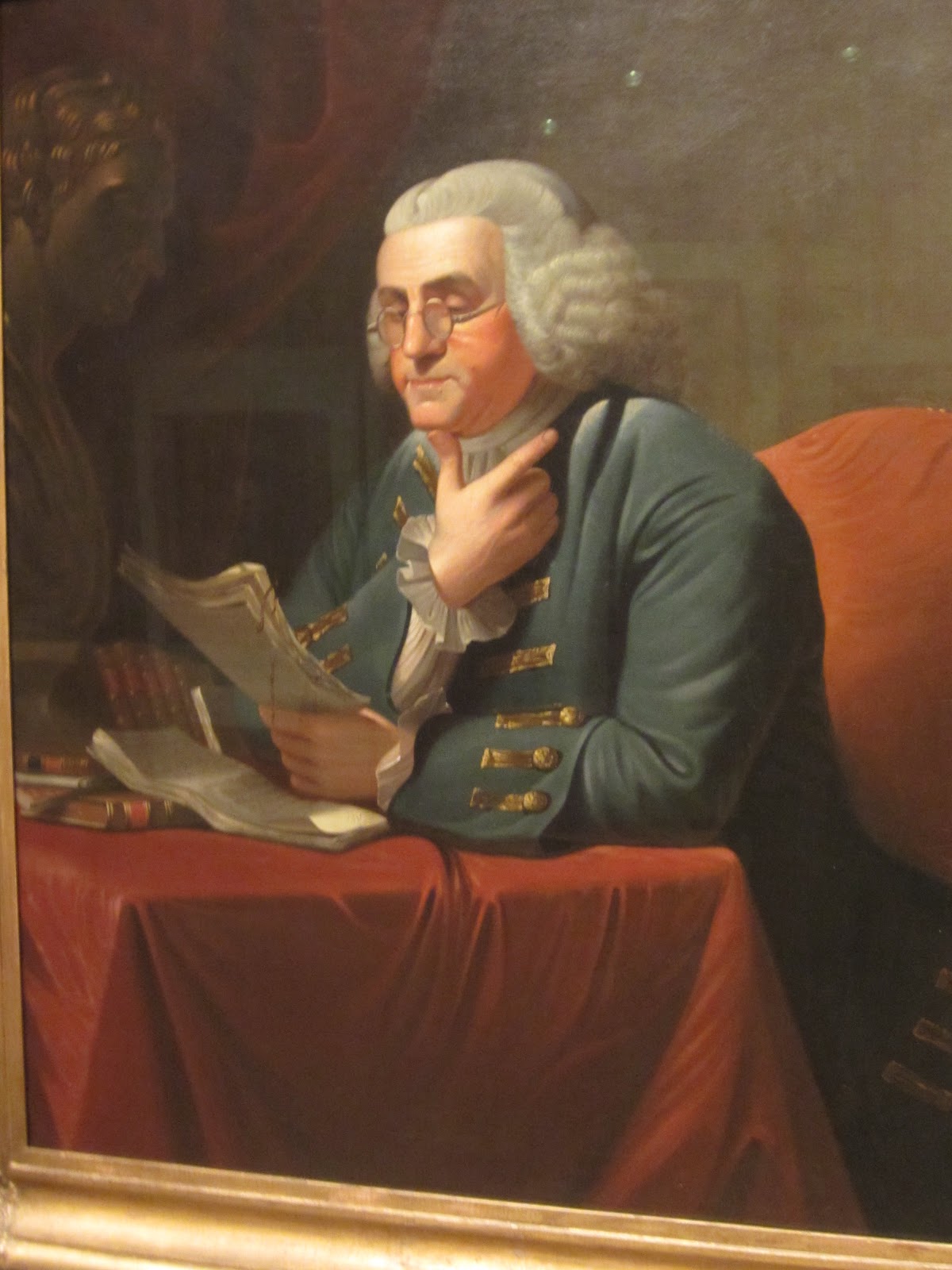
portrait of Benjamin Franklin at the portrait gallery
Benjamin Franklin was born in Boston to Josiah and Abiah Franklin in 1706. He was the 15th of 17 children.  His father was a candlemaker and even at a young age, was considered very bright.  He learned to read at an early age. He loved to swim and one day, held to the strings of a kite as it dragged him through the water.  He invented the first parasail.  He even invented a pair of wooden flippers to help him swim.  He was full of ideas and continually tried out his inventions with his friends.  Because he learned to read so early, his father wanted him to learn to be a candlemaker, but Benjamin hated it.  At the age of 12 he was sent to his brother’s to learn how to be a printer.  He became an apprentice to his brother for 9 years. He loved reading books and soon was saving most of his money to buy more.

“Would you live with ease, do what you ought and not what you please.”
Christ's Church

Unfortunately, Ben was not satisfied with just being a printer’s apprentice.  He wanted to write some of those wonderful stories he read. He even wrote a poem to celebrate the death of Blackbeard the famous pirate. When his brother refused to let him write, Ben did the next best thing – he created a woman named  Widow Silence Dogood and sent letters to his brother under this pseudonym (this is a fake name when a person doesn’t want someone who is reading their story to know their real name).  His brother loved the letters and soon published every single one of them.  Until – he discovered Ben had written all the letters instead.  His brother was furious with Ben!

“Early to bed and early to rise, makes a man healthy, wealthy, and wise.”
pew where Benjamin Franklin sat with his family

After five years working with his brother, he wanted to run his own print shop.  When his brother said no, Ben ran away.  He was only 17 at the time.  He went to New York first, but it was too small and had one printer.  Ben decided to go to Philadelphia which was a much bigger town. It was a long trip for him – by boat and walking, but finally he arrived in Philadelphia.  He managed to find a job as a printer’s helper and soon he made many friends.  Everyone liked his sense his humor.  Soon the governor of Pennsylvania came to visit him and advised his to go back to see his father.  He promised Ben he would help him set up a print shop when he returned.  Ben agreed. His father did forgive him, but his brother did not.

“Better slip with foot than with tongue.”
his signature at the Post Office

He did go to London to purchase a printing press, but the governor never sent money and Ben was forced to work to have food to eat.  He worked in print shops in London and soon had enough money to return home.  He worked for the same printer and after a while, he saved enough money to open his own shop (with a little help from some of his friends). 

“He that can travel well by foot, keeps a good horse.”
Franklin Court - the virtual outline of his home

Ben lent people his books, knowing it was better to have the books read than to let them collect dust on the shelves.  He worked from early morning until late every night.  He saved all his money.  Soon not only did he have his print shop, but he found a girl to marry him – Deborah Read.  They had a happy life together.  They had a son and a daughter.  Soon people up and down the coast of the colonies knew about Ben Franklin and his wit and humor.  He began to print “Poor Richard’s Almanac”, pretending it was written by a poor stargazer.  He wrote bits of proverbs and published them in his Almanac as well.  In one year, he sold over 10,000 copies!!!  He printed the first one in 1733 and continued printing it until 1758 – that’s 25 years!  Some of his most popular sayings were actually old proverbs that he changed.  You may have heard of “A penny saved is a penny earned”.

“Experience keeps a dear school, yet fools will learn in no other.”
wall of his home - artifacts found there

He always saved his money, hating to spend it on what he considered wasteful items.  Imagine his surprise when his wife put a silver spoon in front of him.  She felt if other husbands deserved a silver spoon, so did hers.  She thought he was far more worthy than any of the others.  He was always willing to help others.  Remember when I said he lent his books out to others?  He opened the first public library so everyone could borrow books whenever they wanted.  He also started a school which later became the University of Pennsylvania.

“Don’t throw stones at your neighbors if your own windows are glass.”
chair he would be carried around in

Ben opened a hospital for the poor.  He started the first volunteer fire department as well as organized a night watch to keep people safe at night.  We all know how he loved to print, but did you also know he opened the first post office and became postmaster of Philadelphia?  If not for Ben Franklin, many letters would never have been delivered to other colonies.

“Look ahead or you will find yourself behind.”
artifacts discovered at the excavation site

As the years moved on, Ben was able to go back to what he did as a child – invent things.  He invented the Franklin stove to keep a room warm.  Women loved the stove because it contained the fire without setting them on fire – a huge improvement for women who cooked all day before a fireplace.  Of course most people remember his work with electricity and that infamous kite and key.  True he was not the first to discover the presence of electricity, but he loved to learn how things worked.  Electricity was one of those things and he did many experiments with it.  He soon discovered that if he put a rod on the top of a house, it would conduct the electricity there and keep a house from catching fire when struck by lightning.  His son William was with him and helped him capture lightning in a jar.

“God helps them that help themselves.”
more artifacts discovered at the site

When England was taxing the colonies, Pennsylvania sent Ben to talk with the king.  They hoped Ben could convince the king that the taxes were unfair.  On the trip over, he studied the ocean and all the sea creatures he saw during the trip.  Once he arrived in England, he was a celebrity and they treated him large parties.  Everyone listened when he spoke.  He stayed for 5 years, talking to everyone who would listen to him.  He soon realized he represented not just Pennsylvania but all the colonies in his pleas.  When he returned to America, the colonists wanted to know what he saw and how he spoke with, but most of all they wanted to know if the King was willing to listen to their request.

“When you are good to others, you are best to yourself.”
side view of his home

The King had other ideas. He wanted his taxes but refused to let them have any say in how the taxes would be spent.  He wanted all the money for himself to pay for the wars he kept getting into.  The colonists did not like this. The colonists did not like the way the king treated them.  They felt they came to America to get away from tyranny and here they had no choice but to listen to the king and pay his taxes.  This was unfair.  They sent Ben back to England to speak for them.  This time Ben stayed in England for 10 years. While he was there, his wife died and his son sided with the king and became a Loyalist.  Ben tried to be a peacemaker but it looked like that was not going to work.  If he did not want to be thrown in jail, he had to go home.  So he set sail for America.

“No gains, without pains.”
printing press like what he would use

By the time he returned, fighting had already started in the colonies.  He went to Independence Hall for the Second Continental Congress.  He sat with Thomas Jefferson and advised him on the Declaration of Independence.  When the document was finalized, Ben signed his name.  He said, “We must indeed all hang together, or most assuredly we shall all hang separately.” In other words, if they were going to fight for independence they had to all agree to it or it would never work.   Americans knew they could not win the war alone so they asked Ben to travel to France to speak to their king and ask for help.  He was almost 70 years old when he left for France.

“A lie stands on one leg, truth on two.”
Ben - from our Breakfast with Ben

The French men and women adored Ben.  They invited him to parties and took him to fancy balls.  He told everyone about Washington’s bravery and the determination of the soldiers.  Most of all he spoke about how much the Americans needed the French to help them. Unfortunately the French did not want to be involved in war if they did not think the colonists would win.  Then they would make England angry and this would not work.  Even though the king would not openly help, the French secretly sent goods, weapons, and money.  After the colonists beat the English at Saratoga, the French finally announced their support openly.  They finally believed the little colonists might have a chance of winning.  Ben stayed in France for 9 years.

“Well done is better than well said.”

When the war was won and the Treaty of Paris signed, Ben finally went home. Thomas Jefferson arrived to take his place as ambassador to France.  He was much celebrated when he returned to Philadelphia.  His daughter came to see him.  His job was not done.  He was asked to help write the Constitution.  After many years helping America become a country, Benjamin Franklin died on April 17, 1790 at the age of 84.
Mrs. Gibson, me, Ben, and Mrs. Cochrane

What are some things Ben invented:
·        Lightning rod
·        Flippers
·        Parasail
·        Bifocals (glasses that let you read and see far away at the same time)
·        Franklin stove
·        Leyden jar – where he captured electricity
·        Electric battery (he coined the phrase)
·        He discovered dark colors absorb light and get hot faster; light colors do not – so wear light colors on hot days.
·        Franklin lamps on the streets burned longer
·        Glass harmonica
·        Artificial arm
Ben's headstone at Christ's Church cemetery


His headstone reads:
The body of
B. Franklin Printer,
(like the cover of an old book
Its contents torn out
And stript of its lettering & gilding)
Lies here, food for worms.
But the work shall not be lost;
For it will (as he believ’d) appear once more
Revised and corrected,
By the author.